Saturday, May 31, 2008

Turtle Kills Phone

There is always something interesting that happens on vacation. You can have the benefit of a chuckle at my expense.

Tricia’s mother would never let them have real pets when they were growing up. The only pets they could have were a turtle and I think her mother once went out on a limb and allowed her to have a hamster but he met a mysterious death.

Enough background, Tricia decided she would relive her childhood and bring her sister a pet turtle from Texas. We have been babying this turtle for about a month. He has a Tupperware home with a few rocks and about a quarter of an inch of water. Seemed like a nice thing to do for five dollars.

We had traveled about six hundred miles when I pulled my phone out to see if we could make find a place to stay for the night. It was after this that Murphy's Law kicked in. Coming upon a major traffic slow down I applied my breaks and my phone flew off the console like a downhill skier and of course landed in the only problematic spot in the van; the turtle habitat.

I have comfort in knowing my phone met a speedy death. Only a few flickers that reminded me of the lights on my Christmas tree and it was gone. However, the turtle is a much more expensive gift now. 

Thursday, May 29, 2008

Schedule Clutter


Ecclesiastes 3:11 Weariness is often the result of trying to do more than God intends; which means I am not letting Him order my day.  Think about that for a few moments. God doesn’t intend for one to be rushed, hurried, burdened or tired because we are racing through life trying to cover more miles than we have fuel. He wants control of our entire life including our schedule. When He has control we have perfect order because we are doing exactly what he wants, nothing more nothing less.

I am not being naïve. I realize that there are situations and jobs that require us to work in a manner that is beyond our control. I also realize that 99.9% of the population is waiving their hands in the air thinking I just described their situation.

I am working at this myself.  Busy does not always equate with productive. Busy will usually obtain some praise from those watching our frantic pace but I am becoming more and more convinced that chaos in our lives should be a caution flag and well meaning friends waving the green flag of praise should exchange it for a red or checkered flag. The plumb line is our relationship with Christ and those who love us should hand out speeding tickets when we are racing ahead of where Christ wants us.

We often display weariness like a winner’s trophy. God doesn’t intend for us to burn out or rust out. He simply wants us to be dependent upon Him.

If every thirty minute slot is filled in your day timer you may want to ask yourself these questions.

1.    Am I praying about my schedule?

2.    Am I pursuing ways to eliminate schedule clutter?

3.    Am I prioritizing my schedule in this order? 1) God, 2) Family,  3) Occupation

4.    Am I seeking counsel from others? Proverbs 12:15, Proverbs 19:20

5.    Is the time I spend complaining about my schedule greater than praying, pursuing and seeking counsel combined?

6.    Am I willing to let to admit I have schedule chaos and allow God to order my day?

If the following comments or responses are part of your daily conversation you may be ignoring God’s planning for your life. Like I have time for that! I can’t add a single item to my schedule. I am running on empty. My plate is full. You want me to do what? I am up to my ears with work. I don’t have time for anything else. I can’t help myself I am a workaholic or I have a type A personality. Hobby, you have to be kidding I don’t have time for a hobby. More often than not these types of comments are used to coax someone into throwing a few complimentary bones our way.

If your schedule is so filled God couldn’t call an audible if He wanted you are running the wrong plays.  

A schedule that leaves you panting for breath is not the mark of a Spirit filled life, a fruit of the Spirit or an indication of a mature believer. It simply means that you are in the driver’s seat and at very best Jesus is riding along in the passenger seat.

If you are driving yourself at a break neck pace it might be time to pull in for a pit stop! 
Tuesday, May 27, 2008

Missions Poll

Don't forget to vote in the poll located in the right margin. If you are visiting the Chaordic Zone you have voting privileges

Saturday, May 24, 2008

Forgiveness

I sometimes wonder if forgiveness has become more like a fairy tale in the minds of Christians. Something like Paul Bunyan, Cinderella, Snow White or Jack and the Bean Stalk. My guess would be that one could name more fairy tales than they could instances of actual forgiveness. If you are wondering what forgiveness look like from a Biblical perspective look through the list below. I particularly like the ones that mention your enemies. I haven’t had many enemies in my lifetime but I would have to ask myself some serious questions based on these verses.

 Proverbs 24:17 (NASB95)

17 Do not rejoice when your enemy falls, And do not let your heart be glad when he stumbles;

Would I consider it an appropriate or inappropriate behavior if my enemy stumbles? The spirit would say, “Help your enemy up”. The flesh would say, “Cheer and rejoice. Replay the moment they deserve over and over”. 

Proverbs 25:21 (NASB95)

21 If your enemy is hungry, give him food to eat; And if he is thirsty, give him water to drink; 22 For you will heap burning coals on his head, And the Lord will reward you.

I laughed a little after reading this one. I realize burning coals are not literal burning coals in this passage but it appears that if you do one thing you may not want to do you get two great ones in return. You will not find this explanation in any commentary but I will continue by saying we never go wrong when we follow the Scripture! Some things may appear to be unpleasant, like forgiving your enemies, but with or without the burning coals it will solve a lot of problems even if you have been wronged. 

Take a few moments to move your mouse over the verses below and ask yourself the question, “Am I a forgiving person?” I am sure glad Jesus is forgiving! 

Ex. 23:4, Ex. 23:5

Prov. 19:11

Prov. 24:17, Prov. 24:29

Prov. 25:21, Prov. 25:22

Rom. 12:20

Eccl. 7:21

Matt. 5:7, Matt 5:39–41, Matt. 5:43–46; Matt 5:47,48

Luke 6:27–34

Matt. 6:12

Luke 11:4

Matt. 6:14, Matt. 6:15

Matt. 18:21–35

Mark 11:25

Luke 6:35–37

Luke 17:3, 4

Matt. 18:21, Matt. 18:22

Rom. 12:14, Rom. 12:17, Rom. 12:19, Rom 12:21 

1Cor. 4:12, 1 Cor. 4:13

Eph. 4:32

Col. 3:13

Friday, May 23, 2008

WKU Hilltoppers


A little off topic here but I am on vacation. Western Kentucky University or WKU has a rich history. The basketball team has had some significant achievements that you may not be aware of unless you are a basketball purist.
This is a list of Men's Division I college basketball teams ranked by the number of wins, as of the 2007-08 season. Be sure to notice the team at number 17. I have heard a couple of people in Katy mention them and say they have a decent program as well.
Rank  ↓College  ↓Wins  ↓Losses  ↓Winning percent  ↓
1Kentucky1966621.760
2North Carolina1950784.713
3Kansas1943785.712
4Duke1846808.696
5Syracuse1725796.684
6Temple1689948.641
7St. John's1670850.663
8Pennsylvania1647931.639
9UCLA1646717.697
10Indiana1635884.649
11Notre Dame1630893.646
12Utah1613848.655
13Illinois1585843.653
14Western Kentucky1577771.672
15Oregon State15761162.576
16Washington15641038.601
17Texas1563933.626
18Louisville1556825.654
19Brigham Young1553986.612
20Arizona1547844.647
19 NCAA Appearances
4 Final Fours
39 Conference Titles
28 All Americans

Sports teams have an immense amount of significance to those that follow them. Just think about how much significance our church has in the lives of others. I can't even begin to post the major achievements we have made. We also need to have the same kind of fervor for our church that we have for our favorite teams.


Believe You Will Get Results

A friend of mind recently pointed out this quote to me. "I am looking for a lot of men who have an infinite capacity to not know what can't be done...Henry Ford". Reminds me of the question, What would you do if you knew you could not fail?” Robert H. Schuller". Which reminds me of  Hebrews 11:1 Now faith is the assurance of things hoped for, the conviction of things not seen.
NASB : 1995 Update 

This whole thought begs the question, "What am I doing in my life where I have to be totally dependent upon Jesus for the results?" 

If you were wondering where chaos looms large I think it is right here. Order seldom provokes creativity but chaos will send you right out to the cutting edge. Jump back to Henry Ford for a second. He was looking for men or women with an infinite capacity to not know what can't be done. Henry, sounds like he was my close friend when I only say Henry, also said, "If you think you can do a thing, you're right or if you think you can't do a thing, you're right."

It's not always easy but I want to live my life attempting new things, going new places.  I want to be a vessel that God could choose to use for something out of the ordinary. I don't want mediocrity, lukewarm, ordinary or common. Passion is the desire to make your dreams a reality. Any time that I can spend defining my passions is time well spent. 

Joshua 1:8 urges me to reflect on the Word day and night. Now if I mix an infinite capacity to not know what cannot be done (chaos) with a healthy dose of time in the Word (order) it seems that I might be able to enter The Chaordic Zone! Shouldn't we all test the waters here? "The world has yet to see what God can do through a man/woman who is totally commited to him." - D.L. Moody
Just remember the nemesis to the "Chaordic Zone" is the "Spotlight Effect". Psychologists have shown that the "spotlight effect," as they call it, is a universal experience that distorts our egocentric notion about the degree to which people in groups, like parties and work gatherings, pay attention to us. 

In other words the prescription should read like this; mix an infinite capacity to not know what cannot be done (chaos) with a healthy dose of time in the Word (order), less all of that time you spend admiring yourself in the mirror. Focus not on what you can do for yourself but on what you can to for your Savior!


—Benedict Carey is credited for creating the term "spotlight effect", "It's not all about you," Los Angeles Times, January 13, 2002

Monday, May 19, 2008

EPIC Sunday Morning Bible Study (Part 2)

Part 2 of Epic Bible Study from the Kentucky Baptist Convention Web Site.

Leading an EPIC Sunday School Lesson, Part 2

Saturday 17th May, 2008

I mentioned in Part 1 that Sunday School still works when you work the Sunday School! But the day of blindly accepting mediocre Sunday School is over. The day of putting up with mediocre lessons is gone. It is time to be revolutionary. It is time to expect, to prepare, and to present EPIC Sunday School lessons.

In Part 1 I explained what I mean by EPIC? EPIC is an anagram used by Leonard Sweet in his book, Post-Modern Pilgrims: First Century Passion for the 12st Century World. EPIC stands for Experiential, Participatory, Image-driven, and Connected. Sweet descibes the shift from the modern to the postmodern perspective: from rational to experiential, from representative to participatory, from word-base to image-driven, and from individual to connected.

In Part 1 I applied the first two sections of EPIC (Experiential and Participatory) to encountering God in Bible study in the Sunday morning time we call Sunday School. In Part 2 we will examine and apply the last two sections: Image-driven and Connected.

  • IMAGE-DRIVEN. Today, 60% of adults are visual learners. As a society, we are immersed in images. We are surrounded by billboards, pictures in newspapers and magazines, mail have pictures on envelopes, and training often includes images. Add to all of that the hours spent in front of the television and computer and the number of movies watched, and you begin to see how immersed in visual imagery. The best communicators today know how to utilize this medium. Jesus was well aware of the impact of images. He drew lessons from items in life. What can we do to make our Sunday School lessons to be more image-driven? Tell stories. Share object lessons. Share testimonies. Look for relevant newspaper clippings. Watch for moments in life when God is illustrating the truth for Sunday. Lead participants to share about times when... Use every teachable moment in class and in life. Apply the truth to where they live.
  • CONNECTED. We live in a connected world. We are connected through the internet, through television and radio, and through airplanes. But sometimes we are more aware of what is happening around the world than we are next door. We often become cocooned, closed off. We enter our homes and close the doors. The world is a hurting place in need of ministry and salvation. The body of Christ has healing to offer in Jesus Christ. That means we must re-connect with our world in order to help them to connect to Him. How can we lead Sunday School to be more connected? Lessons must connect with life. Application cannot be ignored. Sunday School classes are great places for accountability to practice biblical truth that has been learned. Next Sunday is the right time to check on progress. Classes can be loving, challenging environments for growth toward obedience. They can also serve as an impetus to reach out in love and to invite into relationships and class. They can mobilize to meet discovered needs in the class and community. Sunday School helps members connect with God, with each other, and with real people in their daily paths.

How can you make your lessons more image-driven and connected? I suggested last time checking out Sticky Sunday School Lessons and Crafting a Sunday School Lesson to Lead to Learning AND Action for more information about lessons with impact. Pause now to consider your usual teaching style? Is your teaching EPIC? Stop now to share about your most memorable Sunday School lesson which was experiential, participatory, image-driven, and/or connected. Press the Comments button below to let others see how Sunday School is life-impacting. Stop teaching mediocre lessons! Be EPIC. Be revolutionary!

EPIC Sunday Morning Bible Study (Part 1)

I want us to be praying about an Epic  Missions Training Center as we prepare for building in the future. EPIC is an acronym for Experiential, Participatory, Image Driven and Connected. Christian education should be an interactive experience. We need to be a leader in training people for work in our church, state, country and world. The following articles provide more information about EPIC. (Sorry about the all caps, I am not screaming at you. Blogger has a mind of its own today and I can't fix it!)

  I found this article on the Kentucky Baptist Convention web site and wanted to share it with you.

Leading an EPIC Sunday School Lesson, Part 1

Friday 16th May, 2008

Many who have given up on Sunday School were never involved in it or else were never involved in EPIC Sunday School. Some give up because they would rather start something new than to roll up their sleeves to change what is not working in Sunday School. And yet there are still so many in our culture who prefer a Bible study time that is connected (before or after) to worship. Sunday School still works when you work the Sunday School!

But the day of blindly accepting mediocre Sunday School is over. The day of putting up with mediocre lessons is gone. It is time to be revolutionary. It is time to expect, to prepare, and to present EPIC Sunday School lessons.

Now, what do I mean? EPIC is an anagram used by Leonard Sweet in his book,Post-Modern Pilgrims: First Century Passion for the 12st Century World. EPIC stands for Experiential, Participatory, Image-driven, and Connected. Sweet descibes the shift from the modern to the postmodern perspective: from rational to experiential, from representative to participatory, from word-base to image-driven, and from individual to connected.

In this two-part series, I want to apply EPIC to encountering God in Bible study in the Sunday morning time we call Sunday School. In Part 1, we will focus on the first two sections of EPIC: Experiential and Participatory:

  • EXPERIENTIAL. The modern way of explaining things has been in a rational, logical, frequently sequential manner. Learning was frequently verbal. Today we live in a postmodern age in which 60% of people are visual learners. They learn more by seeing than by hearing. But many have "been there, done that." They are easily bored with presentation styles and content. Today's learner expects to be immersed in the learning experience. In fact, that is it: they expect learning to be experiences. How can we turn Sunday School into an experience? Consider one experience that happens in churches all across the land: Vacation Bible School. Children, teens, and adults are immersed in a theme. The room and church are decorated. The lessons and activities of the week all relate. Why not meet at Easter in the cemetary and have Mary dressed in biblical costume arrive during the lesson telling about having seen Jesus? Why not bring in roses when you talk about the rose of Sharon? Why not wash feet when talking about the Upper Room? Why not take the group to a soup kitchen to address "in as much as you did it not to the least of these brothers of mine"? During every lesson, you want to make sure that learners have at least this experience: lead them to meet God in Bible study. Lead them to open God's Word. Lead them to listen to Him. Lead them to respond to Him.
  • PARTICIPATORY. The modern way of Sunday School was for the teacher to have the experience of preparation on the way to becoming a subject-matter expert. In this post-modern age, there has been a shift to learners wanting to participate more in the learning experience. Learners today don't want to sit back and be told. Instead, they want to want to do it. They want to discover it for themselves. When you consider that retention in 72 hours is at 90% if you led learners to "say and do" something, this approach to Sunday School makes sense. When we get them involved, they remember and learn more. How can we make Sunday School more participatory?Give them written exercises. Ask questions. Get them into smaller groups. Make assignments. Call for reports. Ask them to read the passage in advance. Lead them to act out a scenario. Have them determine how they should live out a truth; tell them you will ask how they did next week; and then ask them at the beginning of the next lesson.

For more information about lessons with impact, check out Sticky Sunday School Lessons and Crafting a Sunday School Lesson to Lead to Learning AND Action. In Part 2, we will look at the last two parts of EPIC:  Image-driven and Connected. Stop now to share about your most memorable Sunday School lesson which was experiential or participatory. Press the Comments button below to let others see how Sunday School is life-impacting. Stop teaching mediocre lessons! Be experiential. Be participatory. Be revolutionary!

Sunday, May 18, 2008

Defensive Pessimism or Offensive Optimism?

Everyone has heard of defensive driving. Well, I heard a term the other day that I really like. Someone came up with the idea of "defensive pessimism". I like it as a descriptive term but I want to avoid practicing this like the plague. 

"Defensive pessimism" is when you think of the worst possible outcome and then take the necessary steps to avoid it. Since I have heard this I have been in several situations where I see people using "defensive pessimism". The problem is that when you spend your time on avoiding the worst outcome you are missing the opportunity to talk about the best possible outcome.

Some people might mistakingly equate "defensive pessimism" with  risk management. In ideal risk management, a prioritization process is followed whereby the risks with the greatest loss and the greatest probability of occurring are handled first, and risks with lower probability of occurrence and lower loss are handled in descending order. In practice the process can be very difficult, and balancing between risks with a high probability of occurrence but lower loss versus a risk with high loss but lower probability of occurrence can often be mishandled (wikipedia). With risk management you are looking at how far out on the limb you can go, not just the worst possible outcome. How much loss are you willing to endure to attempt to achieve a particular objective. In other words risk management is an effort to obtain the best possible result without unnecessarily endangering the ministry or company. 

The problem with "defensive pessimism" is you forfeit positive results altogether in your effort to insure missing the worst one. 

If your objective is to avoid the worst possible outcome, how do you measure success? Even worse, you can spend so much time trying to avoid something bad that you forget to discover what the Lord wants you to accomplish. 

I for one want to practice "offensive optimism". Wow, I may have just  coined my own term. Regardless I want too invest my energy in an effort to discover what great blessing Jesus has in store for FBC, Katy!


Friday, May 16, 2008

Chaordic Zone

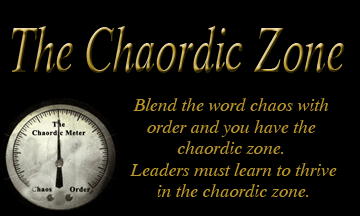
The title of the blog, Chaordic Zone, is a term that I learned in Leonard Sweet's book, Soul Tsunami. He credits Dee Hock creator of the trillion-dollar Visa credit-card empire with actually coining the term. I love wordsmiths that come up with words or descriptions that just make sense. Doesn't make sense to you yet? Allow me to explain. When you take the word chaos and order and you merge the terms together you get "chaordic". When you get these terms to overlap you have the best of both worlds and chaordic leaders see change and chaos as their friends, not enemies. 

Change has been a topic that has consumed my attention for the last few years. Change is not necessarily a term that is synonymous with church. Well I have heard a few people say they love change. The conversation begins and ends with a statement like this..."I love change; you go first." Ok, I am exaggerating a little, but churches don't have change encoded into their DNA. However, this is beginning to change and I am very excited about it. 

Back to the title of the blog, Chaordic Zone. I love it. Wish I had coined it. I didn't but I do want too embrace it. I am not ready to throw out order but I think a healthy mix of chaos goes a long way in keeping everything looking like the early church. Necessity is the mother of invention, discipline is a recipe for success, the first step to getting what you want out of life is deciding what you want and if you want to see church growth you have to enter the "CHAORDIC ZONE". Now say that again like you are introducing a science fiction movie.


Why didn't I Pay More Attention?

In school I can remember wondering about the purpose of High School English. Nouns and pronouns were not my favorite subject (pun intended). I also thought it was pretty funny when they would say, "Verbs, now that is where the action is"; being the analytical type that I am I still think it is a valid question to ask why we need to learn these parts of speech.

Although, I take total responsibility for napping during English I wish there would have been someone that would have given one good reason why these things were important. I can remember asking. I also remember that no one took the question seriously or maybe they just didn't know.

The blog today demonstrates why English is so
 important to folks who study the Bible. Our example comes from Matthew 28:19. Verbs are marked in red. Conjunctions are the words colored green (the green ones in the red I will explain later). Nouns are shaded blue. Pronouns are the words colored blue and the adjectives are underlined in blue. Allow me to pause, I can't believe I care! Not only do I care I am blogging about this so you will care. I admit I have become a grammar Nazi or at least a grammar Nazi want to be. I am studying parts of English. My flesh still rebels and I feel like Charlie Brown AAAAAAUUUUUUGGGGGGGG.

However, when you look at this verse and its syntax (definition at the end of the article) you learn something really cool. The command in this verse is to make disciples. I would have thought the command was to go. When you study the Bible inductively you find little nuances like the example here in Matthew 28:19 that impact your entire theology and this is where the green text inside of the red shading comes in. The green text inside of the red shading is my marking for imperative verbs. Imperative verbs are defined like this...
The imperative mood corresponds to the English imperative, and 
expresses a command to the hearer to perform a certain action by the order and authority of the one commanding. Thus, Jesus’ phrase, “Repent ye, and believe the gospel” (Mk.1:15) is not at all an “invitation,” but an absolute command requiring full obedience on the part of all hearers.
Larry Pierce, Tense Voice Mood. (Ontario: Woodside Bible Fellowship.), TVM5794.

Realizing that our command is to make disciples as we go gives the truth of this passage. If I believed "Go" was the command in and of itself I would miss the point entirely.

Do you see grammar mistakes in the blog? Go ahead, blast me, I deserve it. I should have been paying attention in class.

_________________________________________________________________
Syntax
1 a : the way in which linguistic elements (as words) are put together to form constituents (as phrases or clauses)
b : the part of grammar dealing with this
2 : a connected or orderly system : harmonious arrangement of parts or elements
3 : syntactics especially as dealing with the formal properties of languages or calculi

Inc Merriam-Webster, Merriam-Webster's Collegiate Dictionary., Includes Index., 10th ed. (Springfield, Mass., U.S.A.: Merriam-Webster, 1996, c1993).
