Showing posts with label Logos. Show all posts

Sunday, November 1, 2009

Logos 4

Announcing Logos 4 !!!!!!!!!!!!!!!!!!! The easiest and simplest way to take a look at it is to go to www.logos.com/4. There are many new features and simplifications that I really like. I love the interlinear ribbon that is available in NASB, ESV, NKJV, and KJV.
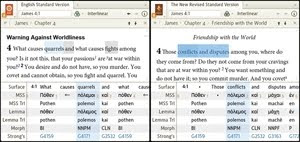
The simpplification I like best is the toolbars. I teach a Logos class at church and now there will be no more glazing over as you explain the multi-step process of getting something on the toolbar. Simply drag the book or feature you want to the toolbar and drop it. PRESTO it is there!

One not so obvious feature is ALT ` (that is the tick mark below the tilde ~) this will give coparison of your top 5 prioritized Bibles.

Go ahead give it a try. You will not be dissappointed and I hear there are some great new packages to investigate.

Monday, July 7, 2008

Logos Community Pricing

Resources are a must for ministry leaders. My favorite way to get books is in the digital format. Logos Library Systems makes this easy. I want to make you aware of an opportunistic way to add books to your digital library if you are on a tight budget. I consider it a sport to find ways to improve the budget so if you have similar aspirations read on. 

Logos has something called Community Pricing (CP). Community pricing is great, for example, I added the fifteen volume R.A. Torrey collection to my library through CP for $44.45. The lowest prices for that collection today is $119.95. Typically CP resources range from $2 to $15. 

Here is how Logos describes CP. "If it costs $4,000 to produce an electronic edition of a book, the costs can be covered by 4 people paying $1,000 each or by 1,000 people paying $4 each. The more likely scenario, though, is that no one wants to pay $1,000 and there aren’t 1,000 people interested in the title, even at $4. But there may be 200 people who would pay $20 each.

Community Pricing is about finding the lowest price that covers the production costs.

We have asked our customers “What is the most you would pay for an electronic edition of this title?” By multiplying the number of customers who would pay a specific amount or more with that price, we are able to generate a chart showing estimated revenue for the product at each price point."


Friday, May 16, 2008

Why didn't I Pay More Attention?

In school I can remember wondering about the purpose of High School English. Nouns and pronouns were not my favorite subject (pun intended). I also thought it was pretty funny when they would say, "Verbs, now that is where the action is"; being the analytical type that I am I still think it is a valid question to ask why we need to learn these parts of speech.

Although, I take total responsibility for napping during English I wish there would have been someone that would have given one good reason why these things were important. I can remember asking. I also remember that no one took the question seriously or maybe they just didn't know.

The blog today demonstrates why English is so
 important to folks who study the Bible. Our example comes from Matthew 28:19. Verbs are marked in red. Conjunctions are the words colored green (the green ones in the red I will explain later). Nouns are shaded blue. Pronouns are the words colored blue and the adjectives are underlined in blue. Allow me to pause, I can't believe I care! Not only do I care I am blogging about this so you will care. I admit I have become a grammar Nazi or at least a grammar Nazi want to be. I am studying parts of English. My flesh still rebels and I feel like Charlie Brown AAAAAAUUUUUUGGGGGGGG.

However, when you look at this verse and its syntax (definition at the end of the article) you learn something really cool. The command in this verse is to make disciples. I would have thought the command was to go. When you study the Bible inductively you find little nuances like the example here in Matthew 28:19 that impact your entire theology and this is where the green text inside of the red shading comes in. The green text inside of the red shading is my marking for imperative verbs. Imperative verbs are defined like this...
The imperative mood corresponds to the English imperative, and 
expresses a command to the hearer to perform a certain action by the order and authority of the one commanding. Thus, Jesus’ phrase, “Repent ye, and believe the gospel” (Mk.1:15) is not at all an “invitation,” but an absolute command requiring full obedience on the part of all hearers.
Larry Pierce, Tense Voice Mood. (Ontario: Woodside Bible Fellowship.), TVM5794.

Realizing that our command is to make disciples as we go gives the truth of this passage. If I believed "Go" was the command in and of itself I would miss the point entirely.

Do you see grammar mistakes in the blog? Go ahead, blast me, I deserve it. I should have been paying attention in class.

_________________________________________________________________
Syntax
1 a : the way in which linguistic elements (as words) are put together to form constituents (as phrases or clauses)
b : the part of grammar dealing with this
2 : a connected or orderly system : harmonious arrangement of parts or elements
3 : syntactics especially as dealing with the formal properties of languages or calculi

Inc Merriam-Webster, Merriam-Webster's Collegiate Dictionary., Includes Index., 10th ed. (Springfield, Mass., U.S.A.: Merriam-Webster, 1996, c1993).